American black women labor worker at forklift driver happy working in industry factory logistic shipping warehouse.
Labour Day just passed, and we know you’re wondering how to handle statutory holiday pay for your employees. Whether you’re an employer striving for payroll accuracy or an employee curious about your pay, this guide is your go-to resource.
And hey, if you’re not in the mood for calculations, we’ve got you covered with our free online statutory holiday calculator. So, let’s get started!
Labour Day is more than just a long weekend. It’s a statutory holiday recognized across Canada, celebrated on the first Monday of September. Employers have two primary responsibilities on this day:
Canada has several statutory holidays, including Labour Day.
For a full list and any updates, you can always refer to the official ESA guidelines, or check out our guide to holiday pay.
Just like with any other public holiday, eligibility for Labour Day pay depends on:
This rule states that an employee won’t qualify for public holiday pay if they, without justifiable cause, either:
Calculating Labour Day pay is similar to other statutory holidays. You’ll need to sum all the wages earned by the employee in the four work weeks prior to the holiday and divide the total by 20. You can use our free online stat holiday calculator.
Vacation pay is included in the Labour Day pay calculation based on three scenarios:
If an employee is on vacation during Labour Day, they can either get a substitute day off or receive public holiday pay for that day, based on their agreement with the employer.
Alright, let’s dive into a real-world example to make this as clear as crystal. Meet Emily, a hard-working Canadian who earns $20 per hour and works a standard Monday-to-Friday week, putting in 40 hours each week.
First, we need to calculate Emily’s total wages for the four work weeks leading up to Labour Day. Emily works 40 hours a week at $20 per hour, so her weekly wage would be:
40 * $20 = $800/week
For four weeks, her total wages would be:
$800 * 4 = $3200
The next step is to divide this total by 20, as per the statutory holiday pay calculation:
$3200 ÷ 20 = $160
So, Emily would receive $160 as her Labour Day statutory holiday pay. This is in addition to her regular pay if she works on Labour Day, or it’s what she’d earn for the day if she takes it off.
And there you have it! Calculating Labour Day pay can be as straightforward as this example. If you’d rather skip the math, don’t forget you can always use our free online stat holiday calculator to do the job in a snap.
Hope this clears up any confusion! Whether you’re an Emily or an employer, understanding Labour Day pay is crucial for a compliant and stress-free holiday. Ready to calculate? Click here to use our free online stat holiday calculator today!
Or instead, rather than stressing over manual calculations – let’s take a look at how PaymentEvolution’s Statutory Holiday Calculator can handle the math.
First, we navigate to the stat holiday calculator.
Then, we enter the province, holiday, and brief employment information for the employee.
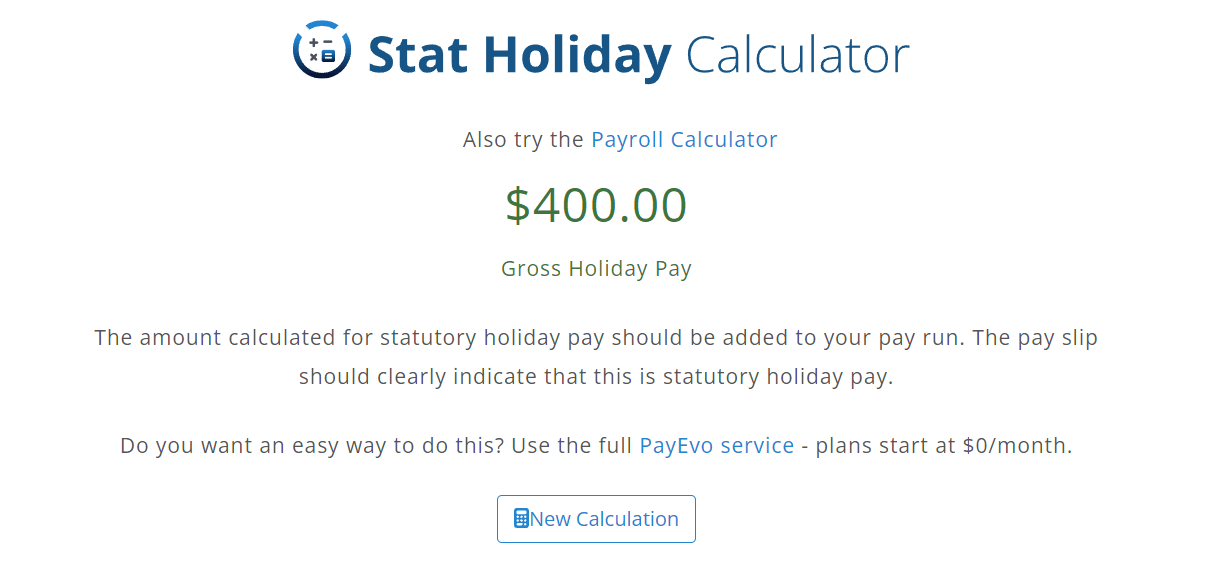
After hitting continue, the calculator works with provincial-specific rules and the inputted information of the employee to generate the correct stat holiday payment.
If you followed these steps to use the stat holiday calculator, follow these steps to add the calculation to your pay run.
Labour Day pay is additional compensation employers are required to provide their employees on Labour Day.
Eligibility is determined by industry-specific rules and the “Last and First Rule.”
Use our free online stat holiday calculator for a quick and accurate calculation.
Navigating Labour Day pay doesn’t have to be complicated. With this guide and our free online stat holiday calculator, you’re all set for a compliant and happy Labour Day!
Ready to calculate? Use our free online stat holiday calculator today!
In the evolving Canadian labor market of 2026, the distinction between a contractor vs employee…
There was a moment, somewhere between 2012 and 2015, when Canadian employers quietly lost control…
What started as a viral TikTok trend has arrived at the legislature. Here is what…
March 3rd has a specific feeling You know the one. It's not quite relief. It's not quite exhaustion. It's that particular fog that settles in…
If you run a Canadian business with 10–50 employees, payroll probably feels routine. You approve…
Cyberattacks aren’t just targeting massive tech companies anymore. They’re targeting small and mid-sized businesses, and…