Our recent webinar, led by Gurdeep Singh, Business Development Manager at PaymentEvolution, jumped into the potential of value-based pricing for bookkeeping services. The session focused on shifting from time-based billing to a model that emphasizes the value delivered to clients while creating new revenue streams for bookkeepers.
“To stand out from your competitors, you need to offer more than just basic bookkeeping.”
Gurdeep emphasized the importance of expanding your service offerings to provide additional value to clients. By going beyond transactional tasks, you position your firm as a strategic partner.
Speaking of value proposition.. what’s yours? Download our free eBook, The Value Playbook for a step-by-step walkthrough on discovering and articulating your value proposition.
During the webinar, we conducted several polls to gain insights into the current practices of bookkeeping professionals and their clients’ priorities. Here’s what we discovered:
We asked participants, “What additional services are you currently offering alongside bookkeeping?” The responses highlighted a trend towards diversifying service offerings:
A significant majority are already offering services beyond basic bookkeeping, with payroll management being the most common. However, there’s room for growth in areas like business advisory services and cash flow forecasting.
We also inquired about pricing strategies with the question, “How comfortable are you with your current payroll pricing (per client)?” The results were telling:
Over 60% of respondents charge less than $200 per month for payroll services, and a significant 32% are unsure how to price their services. This indicates an opportunity to reassess pricing strategies to better reflect the value provided.
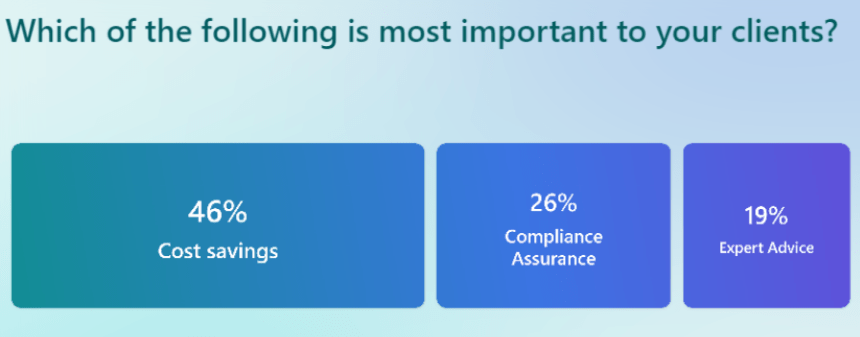
Understanding client priorities is crucial. We asked, “Which of the following is most important to your clients?” The responses were:
While cost savings is a primary concern for nearly half of the clients, a combined 45% value compliance assurance and expert advice. This underscores the importance of positioning your services not just as affordable but also as expert-led and compliant.
Gurdeep outlined a step-by-step action plan to help firms transition to value-based pricing from a time-based model.
Begin by reviewing your existing pricing structure.
“Determine if it aligns with the value you’re delivering or if it’s limiting your profitability and growth potential.”
Look for areas where you can add value beyond transactional work.
“Look at your services and identify where you can add value beyond the transactional work.”
Quantify these benefits to understand their worth to your clients.
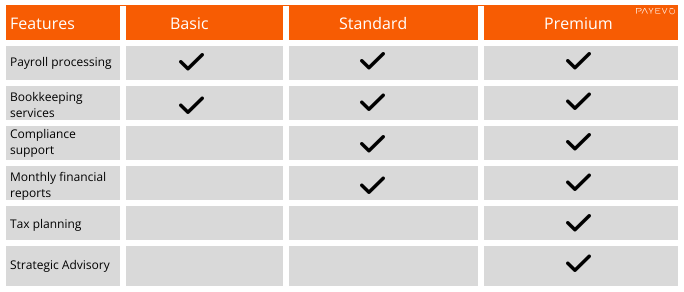
Develop different tiers of services—basic, standard, premium.
“Each tier should progressively add more value and be priced accordingly.”
This approach provides clients with options and highlights the benefits of upgrading.
Be transparent when introducing new pricing.
“Explain the value and the additional services they will receive.”
Your value is so important here. It could be as simple as avoiding one simple payroll calculation mistake or even a late filing that can cost business owners anywhere from $1000 to $7500 in penalties. Use real examples or testimonials to demonstrate positive impacts.
After implementing value-based pricing, monitor the impact on client satisfaction and profitability.
“Be prepared to adjust your pricing or service offerings based on client feedback and your evolving value proposition.”
Gurdeep shared insights on how PaymentEvolution structures its own tiered pricing model as an example.
“For PaymentEvolution, we have our tiers set up in a way that it’s in accordance to client size, but it doesn’t have to be this way. Think about setting your tiers up based on provided value.”
Each tier offers a set of features tailored to different client needs, ensuring they receive the most relevant services.
Addressing potential client concerns is crucial when transitioning to a new pricing model.
“When introducing value-based pricing, be transparent with your clients. Explain the value and the additional services they will receive.”
Continuous improvement is key to the success of value-based pricing.
“After implementing the value-based pricing, monitor the impact. Track your client satisfaction, client retention, and profitability.”
Be prepared to refine your approach based on real-world results and client feedback.
The webinar concluded with a Q&A session, where Gurdeep addressed value-based pricing questions from the audience of bookkeepers. Here’s our highlights:
“You can look at what works best for your clients in terms of their size, take into account your services and value holistically, and then set your tiers accordingly. We recommend thinking in three tiers of involvement. Tier 1 is minimally involved, serving a job. Tier 2, more involved, serving as a solution. Tier 3 is fully autonomous service that encapsulates every need of the client.”
“It’s okay to say no to clients who aren’t a good fit for the value that you’re providing. Clients that aren’t a part of your niche, and don’t stand to gain from your value is what we’re trying to avoid for all parties.“
“For example, Vancouver might have different pricing than Ontario or Halifax. You need to consider the regional market when setting your prices.”
“This is dependent on your value proposition, location, and types of clients. Your prices and service tiers can only stand to take stress away from your clients and provide a clear outline of your services in entirety.”
You can’t just raise prices and expect happy clients. You need to think about your value proposition and all of the services your clients stand to gain from your practice. Once your value is clear, implementing value-based pricing can significantly enhance your firm’s profitability and client relationships.
Ready to implement these strategies? Access our exclusive eBooks designed to help you handle awkward conversations and discover your value proposition while transitioning to value-based pricing.
In the evolving Canadian labor market of 2026, the distinction between a contractor vs employee…
There was a moment, somewhere between 2012 and 2015, when Canadian employers quietly lost control…
What started as a viral TikTok trend has arrived at the legislature. Here is what…
March 3rd has a specific feeling You know the one. It's not quite relief. It's not quite exhaustion. It's that particular fog that settles in…
If you run a Canadian business with 10–50 employees, payroll probably feels routine. You approve…
Cyberattacks aren’t just targeting massive tech companies anymore. They’re targeting small and mid-sized businesses, and…