

Last week, Prime Minister Mark Carney announced his new federal cabinet at Rideau Hall. With this change in leadership, small businesses across Canada are closely watching how the new administration will shape economic policy, particularly around taxation, affordability, and workforce management.
One of the administration’s first fiscal policies is a middle-class tax cut that will affect more than 22 million Canadians. The change, announced as part of a broader economic strategy, directly impacts small businesses that manage employee payroll and tax withholdings.
As a payroll software provider, we recognize how changes in federal policy, especially mid-year tax adjustments, can affect how business owners handle payroll, remittances, and compliance. This blog post outlines the tax change, its implications for small businesses, and how PaymentEvolution can support a seamless transition.
Summary of the Proposed Changes
- The lowest federal income tax rate is being reduced from 15% to 14%.
- This tax cut applies to taxable income under $57,375.
- The average rate for 2025 will be 14.5% due to a mid-year start date.
- CRA will update its payroll deduction tables for July to December 2025.
- Businesses must update payroll calculations to comply starting July 1, 2025.
- PaymentEvolution automatically integrates all CRA tax changes, ensuring accurate withholdings and compliance.
What the Tax Cut Means
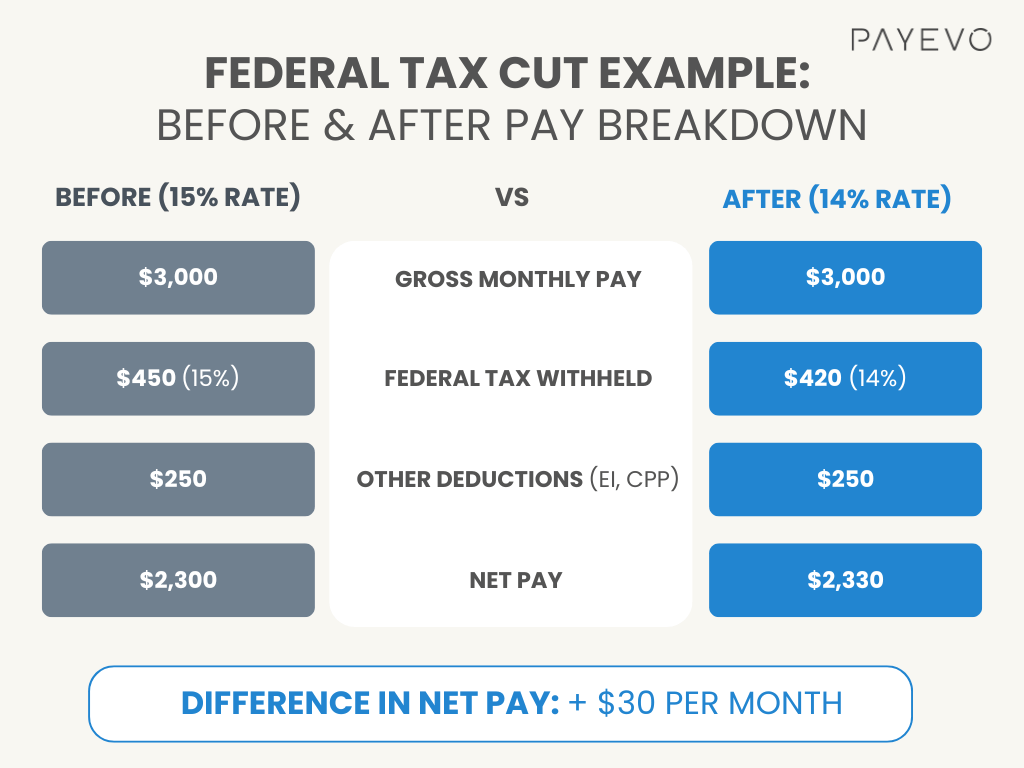
Effective July 1, 2025, the lowest marginal personal income tax rate will be reduced from 15% to 14%. This rate applies to the lowest federal tax bracket, covering Canadians with taxable income of $57,375 taxable income or less.
According to the Government of Canada, this policy will provide more than $27 billion in cumulative tax relief over five years. The tax cut is designed to ease financial pressure for millions of Canadians amid inflation and tariff-related challenges.
This change is part of a wider affordability agenda announced by the Carney administration and will directly impact payroll processes beginning in the second half of 2025 (BlogTo).
How It Will Be Implemented
Because the tax cut comes into effect mid-year, the average rate for 2025 will be 14.5%. The full annual rate of 14% will apply starting in the 2026 tax year (Bloomberg).
To support this change, the Canada Revenue Agency (CRA) will update its source deduction tables for July through December 2025. These tables guide pay administrators on how much income tax to withhold from employee pay.
Employers and payroll administrators are expected to apply the new tax rates starting July 1, 2025. Employees will begin to see reduced federal tax withholdings reflected in their pay cheques. Those who don’t see immediate changes in their net pay may still benefit when filing their 2025 tax returns in spring 2026.
What It Means for Small Business Payroll
For small businesses, these updates require immediate action. Payroll systems must be adjusted to reflect the new withholding rates to remain compliant with CRA guidance. If these changes are not implemented correctly, it could lead to:
- Under- or over-withholding of employee taxes
- CRA penalties or audit flags for non-compliance
- Employee frustration due to incorrect pay calculations
These adjustments must be made mid-year, which can make payroll more complicated than typical year-end updates.
The PaymentEvolution payroll platform automatically syncs with legislative changes, ensuring employers remain compliant with the latest tax legislation, no manual updates required. Try us out for free here: https://paymentevolution.com/Payroll
Why Manual Adjustments Can Be Risky
Keeping up with legislative changes and manually adjusting payroll calculations can be time-consuming and prone to error. Even a small misstep in tax deductions can create problems for both the employer and employees.
Because these updates are not one-size-fits-all, employers must ensure their payroll systems apply the correct rates to the correct tax brackets, factoring in various employee compensation scenarios.
This is especially important for businesses operating across multiple provinces, each with its own additional tax requirements and labor regulations.
How PaymentEvolution Supports Businesses Through Tax Changes
PaymentEvolution is one of the fastest payroll software providers in Canada to respond to tax and legislative changes. We monitor federal and provincial updates in real time and automatically apply the required changes to payroll tax tables as soon as they are issued by the CRA.
Here’s how we help:
- Real-time compliance: Tax updates are built into our platform as soon as new tables are published.
- Automation: No need for manual downloads or adjustments—your payroll stays accurate and compliant.
- Security: All updates are applied securely, reducing risk and ensuring audit readiness.
- Scalability: Whether you manage five employees or five hundred, PaymentEvolution adjusts accordingly.
With these updates in place, small business owners can continue running their operations without the burden of interpreting and applying tax changes.
Reducing Risk of Penalties
Failing to adjust for the updated tax rates could result in incorrect tax withholdings, which can trigger fines or additional CRA scrutiny. Businesses that process payroll manually or through outdated systems are particularly vulnerable to these errors.
By using a modern payroll system that adapts instantly to regulatory changes, small businesses reduce administrative overhead and ensure full compliance.
Empowering Business Owners to Focus on Growth
The goal of the new tax cut is to improve affordability for Canadians and drive consumer confidence. For business owners, this creates an opportunity to reinvest in growth, hire talent, and improve internal operations.
By outsourcing payroll tax compliance to a trusted platform like PaymentEvolution, small business owners can:
- Save time and reduce admin errors
- Ensure employees receive accurate pay
- Minimize audit and penalty risks
- Stay informed on ongoing legislative changes
With compliance handled, teams can shift their focus toward scaling their operations, improving customer experience, and pursuing strategic initiatives.
Final Thoughts
The Federal Government’s middle-class tax cut is designed to provide broad financial relief for Canadians and support national affordability goals. For employers, the change brings important adjustments to payroll processes and tax administration.
By using a payroll provider that proactively updates tax tables and manages compliance on your behalf, small businesses can navigate changes smoothly. PaymentEvolution ensures that your payroll operations remain accurate, efficient, and fully aligned with CRA requirements.
For more information on staying compliant during tax changes or to explore how PaymentEvolution can help your business, visit our website here: https://paymentevolution.com/Payroll.
Prefer to listen? Stream the audio version on our podcast, now streaming on Spotify!


